For gyms, studios and personal trainers
Know who is
still training.
A membership list tells you who paid. It does not tell you who stopped coming three weeks ago — which is the one you could still do something about.
30 days free · no card · your members never pay

Churn is quiet.
Nobody cancels. They come in less, then less, and one month the standing order stops and you find out on a bank statement. By then the conversation that would have kept them is four weeks too late.
The information that would have caught it was always in the building — who walked in, and when. It was just never written down anywhere you could read it.
The dashboard
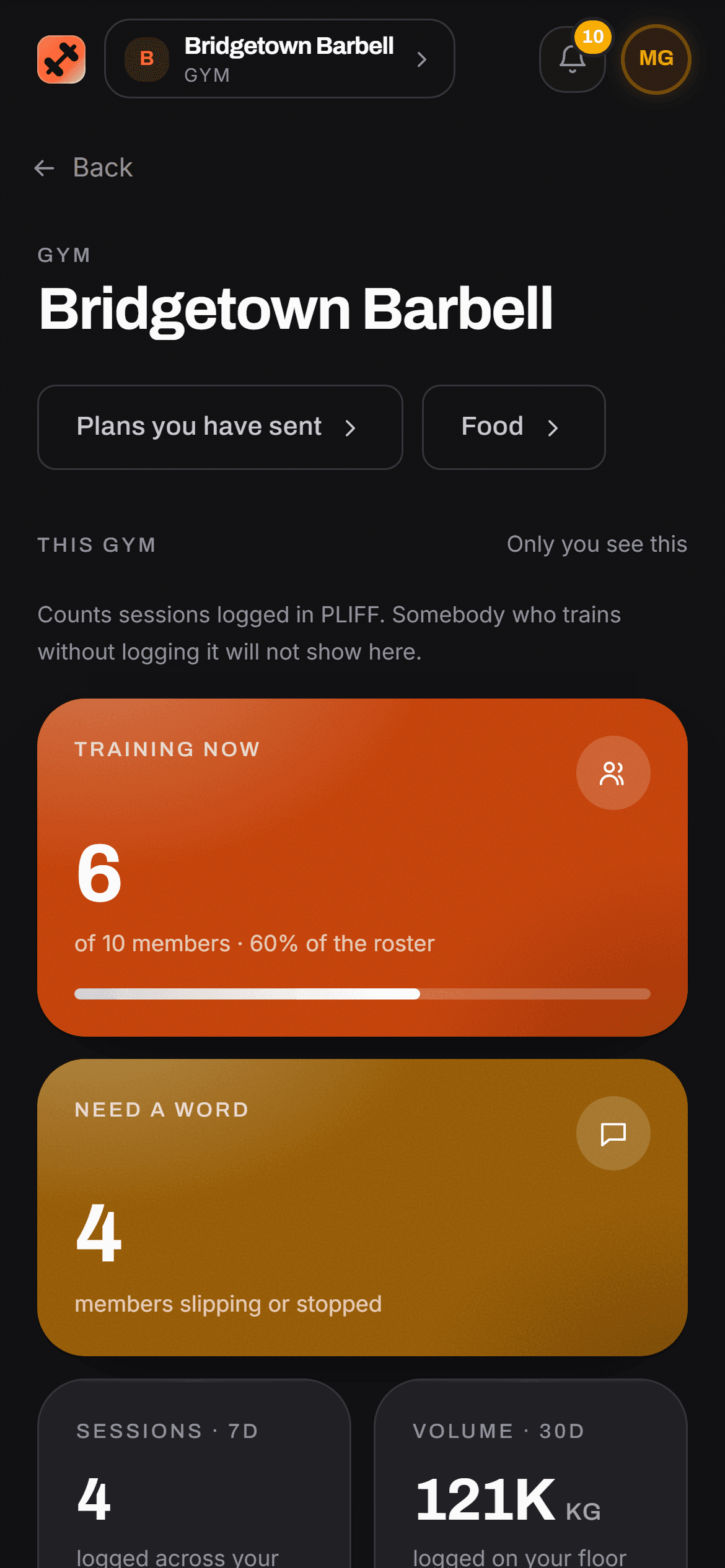
Three things, on one screen.
Captured from a running gym account rather than drawn. An owner deciding whether to move a roster onto something new can smell a mockup, and a screenshot of a feature that does not exist is a promise you then have to keep.
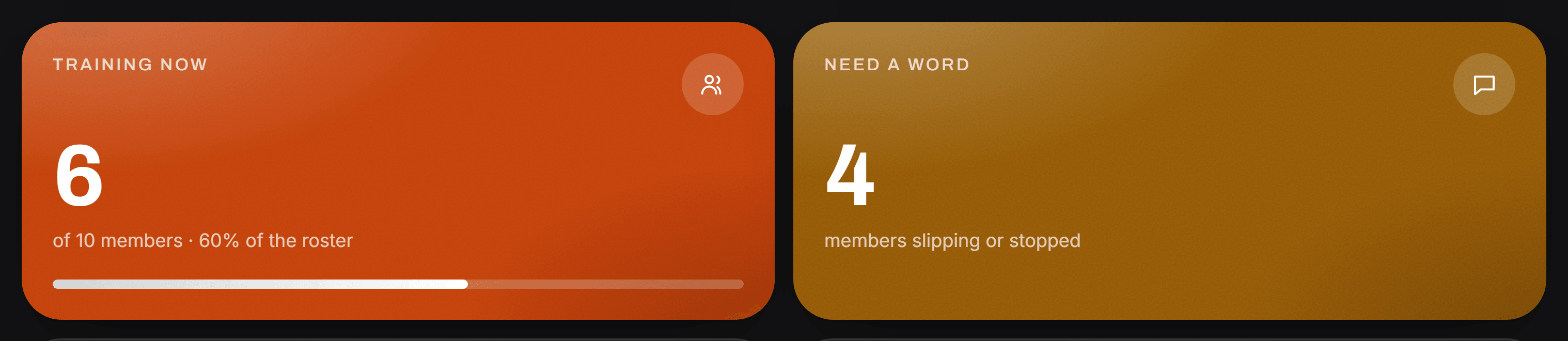
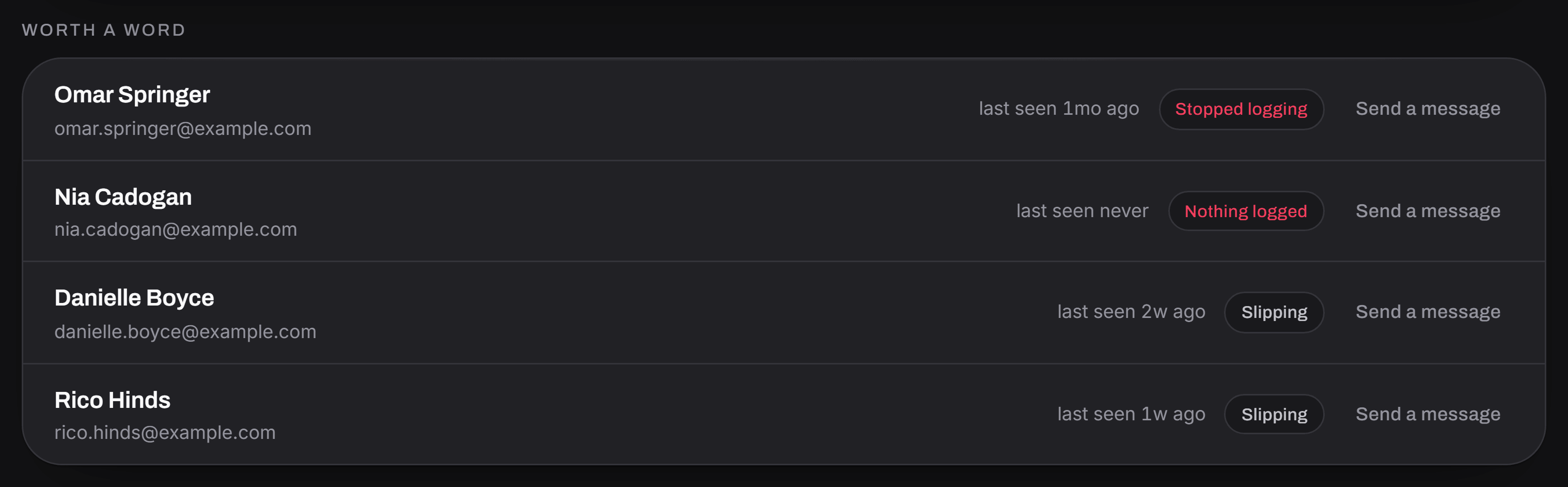
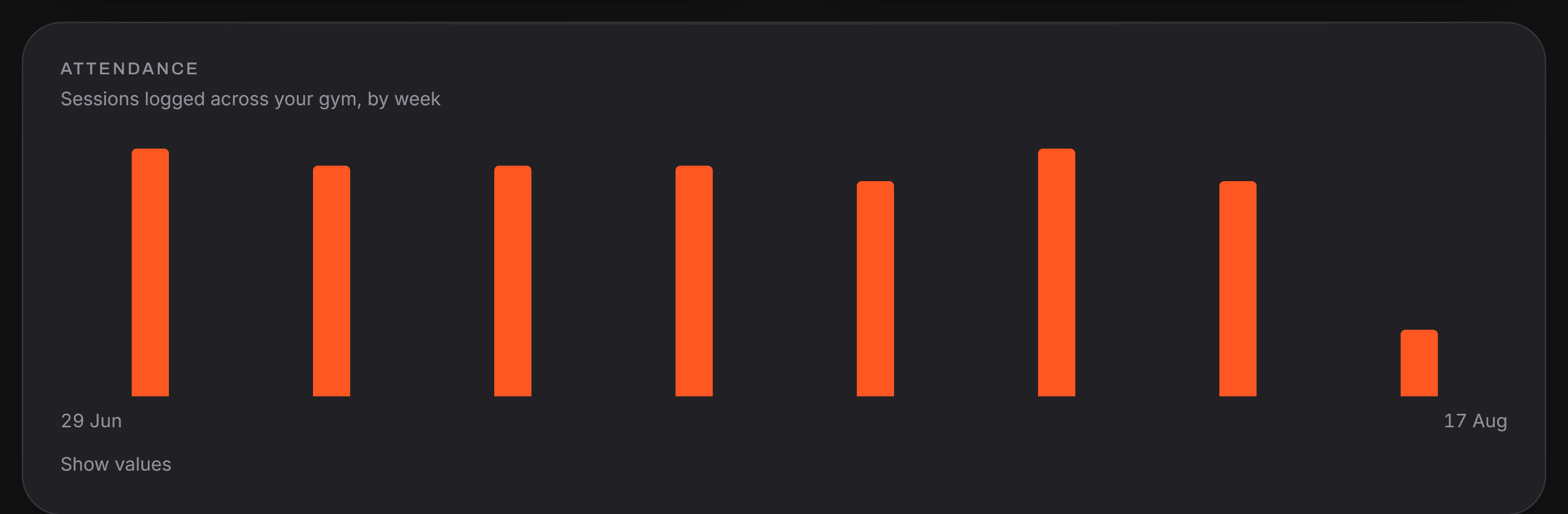
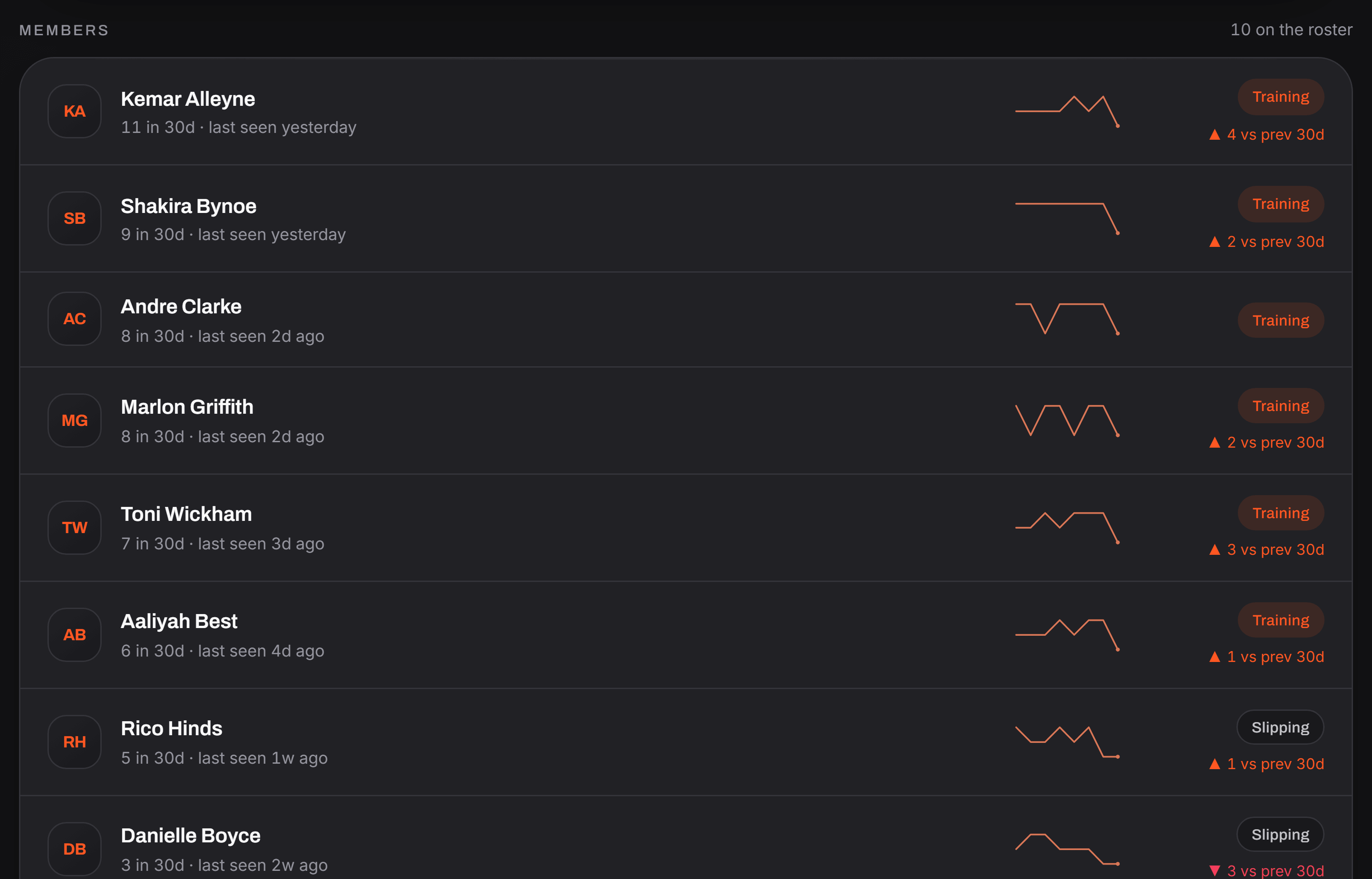
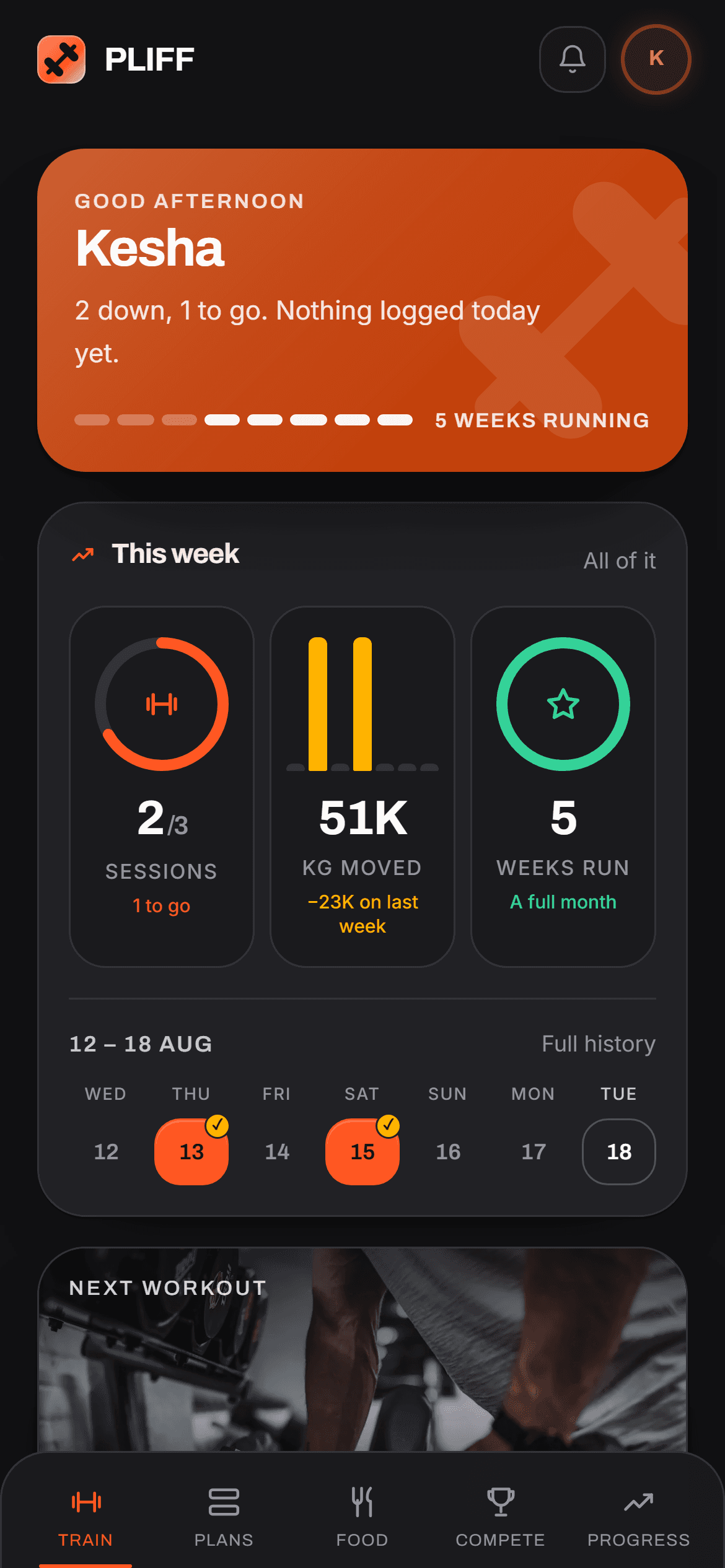
The same screen on the floor, between sets, on the phone already in your pocket.
A code on the wall is the whole onboarding.
One
Make the gym
Name it. That is the setup. You get a join code and a roster with you on it.
Two
Hand out the code
WhatsApp it, print it, put it on the desk. Or send invitations by email from the roster — both work, and you can do both.
Three
Watch the roster fill
Everyone who joins on your code is covered by your plan. Nobody is asked for a card, and nobody has to be added by you.

The part members ask about
You see the training. Not the person.
Staff see attendance, sessions and volume, because that is what a gym is paying for. Bodyweight is never shown to a coach or an owner, does not appear on any export, and there is no setting that could reveal it by accident. Food is shared only while the member allows it, and they can stop at any time.
Members cannot see each other’s training either. This is not a leaderboard your floor did not ask to be on.
It is worth being blunt about why: a roster only works if the people on it are willing to log honestly, and nobody logs honestly into something they think their gym is reading over their shoulder.
Something to turn up for
Put a challenge on the wall.
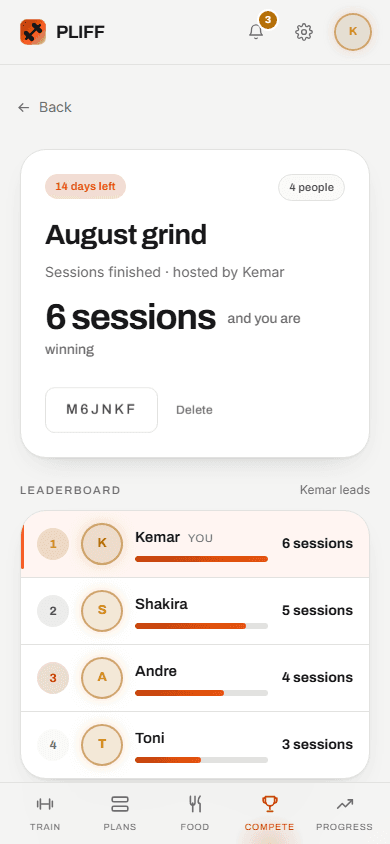
Start one — most sessions, most weight moved, or most reps, over any window up to ninety days — and you get six characters to hand out. Anyone who has them is on the board: your members, the ones who have gone quiet, the ones who have not joined yet.
It is the cheapest retention you will ever run, and the scores keep themselves — they come off sessions people are logging anyway, so there is no sheet at the desk and nobody has to be trusted to update it.
Members can start their own, too, and send each other plans. A floor that trains together is a floor that renews.

Pricing
A band, not a seat count.
Counting seats starts an argument at renewal about the ones nobody used. Pick the band that covers your floor and stop thinking about it.
Coach
An independent trainer and their clients.
$900
BBD a year
Up to 20 members
Studio
A boutique studio or CrossFit box.
$1,800
BBD a year
Up to 50 members
Gym
A neighbourhood gym with a full floor.
$4,200
BBD a year
Up to 150 members
Club
A large club or a multi-site operator.
$8,400
BBD a year
Up to 400 members
Every band carries a fifth over its cap, so signing somebody up in March never locks anybody out — you move up at renewal, with the roster in front of you, not on the day one person joins.
Prices in Barbados dollars, sold as a twelve-month term and paid by local bank transfer or mMoney — no card, and no overseas payment processor to argue with. Prepaid codes are available for anything you sell at the desk.
Before you move a roster
What owners ask first
Do my members have to pay?
No. Anyone who joins on your gym code or by your invitation is covered by your plan and is never asked for money. They get the whole app — the training log, the offline mode, their own history — as part of your membership, and it keeps working for them if they later leave.
How do I get my existing members on?
Two ways, and you can use both at once. Send invitations by email straight from the roster, or share your join code however you like — on WhatsApp, on a card at the desk, on the wall. Somebody with the code joins in about a minute, and the roster fills up as they do.
What can I actually see about a member?
Whether they are training, when they last came in, how their attendance has run week by week, and how much work they are doing. You can open a member and see their sessions and their lifts. What you cannot see is their bodyweight — not on the screen, not on an export, and there is no setting that would reveal it.
I have several trainers. Do they see each other’s clients?
Only if you want them to. Assign a member to a coach and that coach sees their own clients rather than the whole floor. Unassigned members stay visible to every coach, which is what a gym looks like on the day it signs up, so turning this on is a decision per person rather than a switch that empties everybody’s screen. Owners always see the floor.
Can I write my members’ programmes?
Yes. Build a plan once and assign it to a member, or to several. They see it on their Train screen as the programme to follow, and PLIFF handles the weights from there — the load for every set, session after session, without you doing the arithmetic for thirty people.
How do I pay, without a card?
A local bank transfer or an mMoney payment, in Barbados dollars. You raise the order in the app, it gives you a reference to quote, and access opens once the payment is confirmed against the statement. Prepaid codes are available for anything sold face to face. Card payment is wired but not switched on — the rails that work on the island come first.
What if a member leaves the gym?
Remove them from the roster and you stop seeing their training. Nothing of theirs is deleted — the account, the history and the records belong to the member, not to the gym. That is deliberate, and it is what makes members willing to put their training in it in the first place.
What happens when the trial ends?
You get 30 days free with no card and no obligation. If you do nothing at the end, the gym dashboard stops and nothing is lost — your roster, your plans and your members’ training are all still there when you pick it up again.
Start with one member.
Make the gym, put yourself on it, and see what the screen tells you. It takes about a minute and costs nothing for a month.