Workout tracker · gym log · progressive overload
Stop deciding
what to load.
Most workout apps are a notebook with a keyboard — you still work out the weight, they just write it down afterwards. This one picks the number, set by set.
30 days free · no card · works with no signal
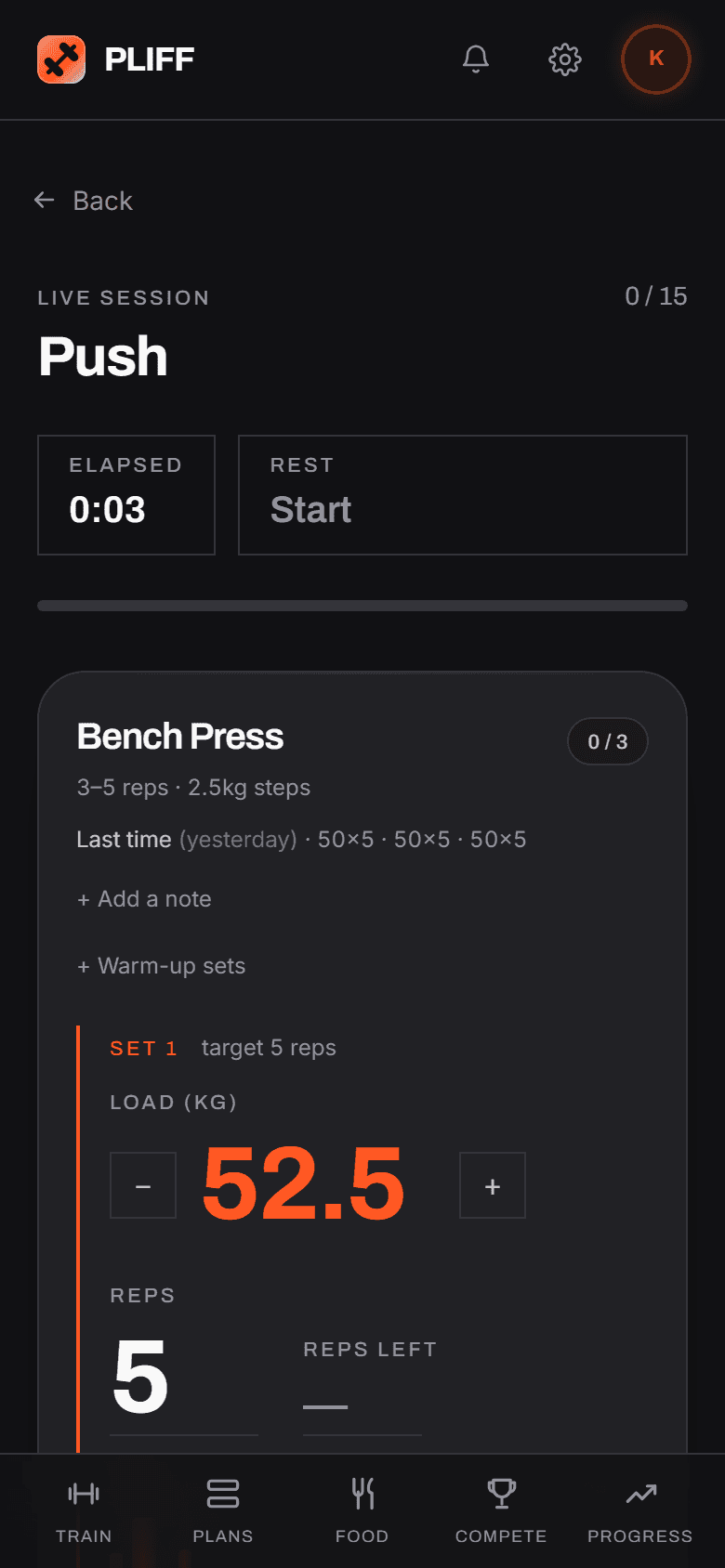
How it decides
It reads the set you just did.
You log the set
Weight, reps, and how many you had left in you. That last one is the whole signal — it is the difference between a set that was hard and a set that was easy at the same number.
It moves the next one
Two reps left over means the weight was light, so the next set goes up. Missing the rep target means it comes down. This happens between sets, not next week.
And next session starts there
When you finish, the session you will do next time is already written — each lift at the weight this one earned. Nothing to plan on the way to the gym.
One step at a time, and only ever one. Nothing here doubles your squat in a fortnight — it adds the smallest jump your gym has plates for, over and over, which is the boring thing that actually works.
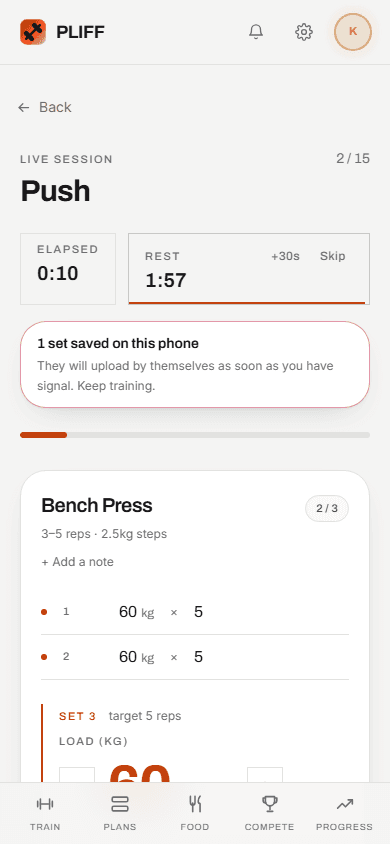
No signal, no problem
Gyms have terrible reception.
So PLIFF does not need any. Add it to your home screen and it opens, logs and finishes a session with the phone in aeroplane mode. Everything you log is held on the device and uploads itself when you are back on — you will not notice it happen.
Including the end of the session. Forget to press Finish and walk out, and it does not credit you with the hour you spent in the car — the session ends where your last set was.
The arithmetic you were doing in your head.
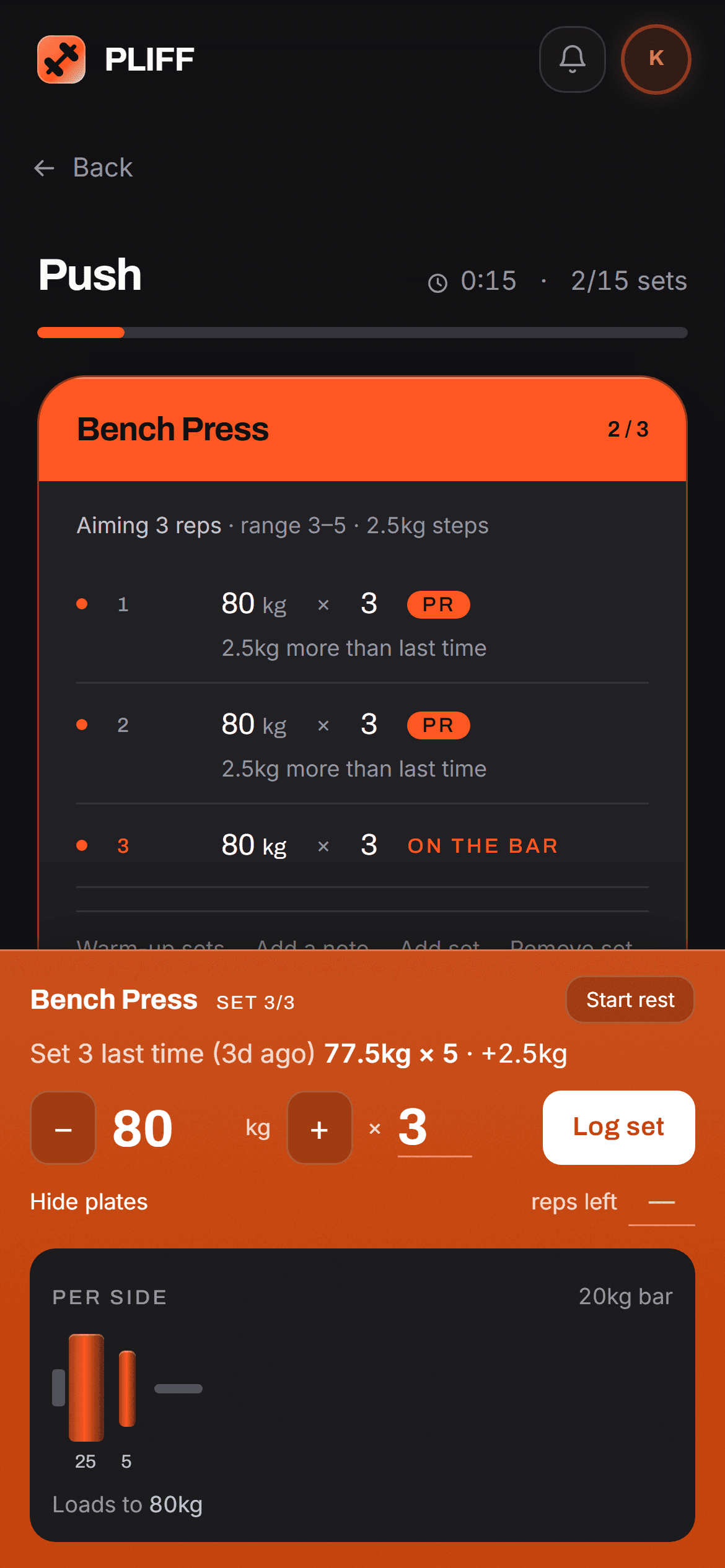
Plate maths
Every barbell weight comes with what to put on the bar — against the plates your gym actually owns, not a textbook set.
Warm-up ramps
Built from the working weight. Bodyweight lifts get a rep ramp instead, because a press-up has no percentage.
Rest timer
Starts itself when you log a set. Buzzes when it is time, without you finding the clock.
Records, caught
A set that beats your best is marked as you log it, not discovered a month later.
Last time, in front of you
What you did for that same set, last session, next to the box you are typing into.
What a plan trains
Every plan shows where its sets actually go — 43% shoulders, 29% arms — instead of a label somebody typed.
Train with people
Nobody quits the week they are losing.
Motivation runs out. Being four sessions behind somebody you know does not. PLIFF has the three things that actually keep people coming back, and none of them is a streak badge.
- Add a friend
- By name, by @handle, or by their exact email. Both of you have to agree — nobody appears in your app, or you in theirs, without accepting.
- Send them a plan
- Offer any plan you have built, with a note. They take it or they leave it, and taking it copies it into their account so the weights follow their history, not yours.
- Start a challenge
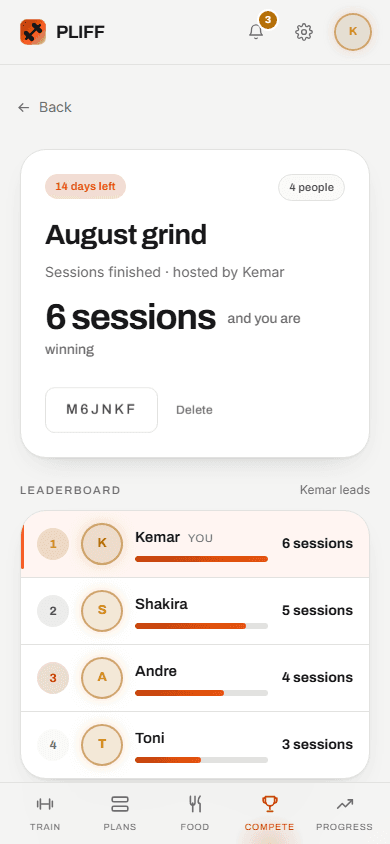
- Most sessions, most weight moved, or most reps — over any window up to ninety days. Invite your friends in one tap, or hand out the six characters to anybody.
Your friends see the scoreboard. They do not see your training log, your lifts or your bodyweight — a challenge shares one number, and nothing else follows it.
Yours
You can take it with you.
Export every session, every lift and every measurement as JSON or CSV, whenever you want, without asking. Close your account and the training is deleted with it rather than kept somewhere out of sight.
Your bodyweight is never shown to a gym or a coach, and there is no setting that could reveal it. If you train at a gym on PLIFF they see your attendance and your volume — that is all, and leaving stops it.
Cost
$60 BBD a year.
Which is about $5 a month, paid as one twelve-month term. The first 30 days are free and no card is asked for — there is nothing to cancel if you decide against it.
If your gym is on PLIFF, you pay nothing. Join on their code and you are covered.
Before you switch
What lifters ask first
Does it tell me what weight to lift?
Yes, and that is the reason it exists. Pick a plan to start from and PLIFF sets the load for every set — the next one while you are still standing there, and the whole of next session once you finish. Log a set that went well and it adds weight. Log one that went badly and it backs off. You never plan a number again.
Does it work offline?
Yes. Add it to your home screen and it runs with no signal at all, which matters in a basement gym or anywhere near the squat racks. Sets logged offline are held on the phone and upload themselves the moment you have signal again — including finishing the session, so the timer does not keep running on the walk home.
Do I have to be on Wi-Fi to start a workout?
No. Once the app has been opened on your phone it starts, logs and finishes sessions without a connection. Nothing waits for a network.
Does it work out the plates for me?
Yes, and against the plates your gym actually owns rather than a textbook set. Tell it what is on the rack once and every barbell weight comes with the loading — what to put on each side, in the order you would put it on.
What about warm-up sets?
It builds the ramp for you from the working weight, and it does it for bodyweight movements too — a rep ramp rather than a percentage one, because a press-up does not have a percentage.
Can I use my own programme?
Yes. Start from one of the built-in plans or build your own — lifts, sets, rep ranges, supersets, notes. You can change a session while it is running, add a lift or drop one, and when you finish it asks whether that was a one-off or the plan from now on.
Does it track personal records?
Yes. A set that beats your best on a lift is marked as it is logged, and the progress screen charts strength over time along with an estimated one-rep max, so you can see the line rather than remembering the numbers.
Can I track my bodyweight and my food?
Both. Bodyweight is charted alongside your strength so you can see the two together, and it is private — no coach, no gym and no export ever shows it. Food logging is there with daily targets, and if you train at a gym on PLIFF you decide whether your coach sees it.
Can I train with my friends?
Yes. Add them by name, @handle or their exact email — both sides have to accept — and then you can send each other plans and start challenges. A challenge counts sessions, weight moved or reps over a window you choose, and anybody with the six-character code can join it.
If I add a friend, can they see my workouts?
No. Friends see your name and the score on any challenge you are both in. They cannot see your sessions, your lifts, your records or your bodyweight. Sharing a plan sends the plan, not your training.
What happens when somebody sends me a plan?
It waits for you on the friends screen with whatever note they added, and nothing changes until you take it. Accepting copies it into your own library, so the weights are worked out from your history rather than theirs — and you can edit it afterwards like any plan you built yourself.
Is my training data mine?
Yes, and you can take it with you. Export everything as JSON or CSV whenever you want, and closing your account deletes the training too rather than hiding it. Joining a gym lets that gym see your attendance and volume; leaving it stops them, and nothing of yours goes with them.
What does it cost?
Every account starts with 30 days free and no card is asked for. After that it is $60 BBD for a twelve-month term — about $5 a month. If your gym is on PLIFF you pay nothing at all: their plan covers you.
Which phone does it need?
Any of them. PLIFF runs in the browser and installs to the home screen on both iPhone and Android — there is no app store, no download, and no separate version to keep updated.
Is it a replacement for a coach?
No. It does the arithmetic a coach would otherwise do between sets. It knows nothing about your technique, your sleep or your shoulder. A good coach is still a good coach — PLIFF just stops them spending your session doing sums.
Log one set.
That is enough for it to start deciding. A month free, no card, and it works before you have left the house.